Mon-Thurs 8:00 AM - 4:30 PM | Fri 8:00 AM - 2:30 PM
Imagine this: Suddenly, the lights flicker as you’re watching your favorite show’s season finale. Your TV turns dark a moment later. It breaks your heart. Was that merely a spike in power? Does your pricey TV now seem like a paperweight?
The silent murderers of the technological world are power surges. They happen without warning, and the damage is already done when you realize something is off. The problem is that not all gadgets are created equal. While some of your gadgets can withstand a lot of damage and continue to function, others are just sitting ducks when a surge occurs. The top five electrical gadgets that are most vulnerable to power surges will be covered in this guide, along with the reasons for their vulnerability and practical precautions you can take.
Let’s clarify our understanding of the situation before getting into the susceptible gadgets. In essence, a power surge is an abrupt rise in voltage above the typical 120 volts passing through your outlets. Even though these spikes only last a thousandth of a second, your electronics could be destroyed in that short amount of time.
There are different explanations that cause electricity spikes. The dramatic ones that everyone thinks of are lightning strikes, but they don’t happen very often. More frequently, surges happen when the electricity company switches grids or when powerful equipment like air conditioners or refrigerators turn on and off. Sometimes you may even experience a surge due to your neighbor’s defective wiring.
The really sneaky part? The majority of surges are mild and don’t destroy your gadgets right away. Rather, like death by a thousand cuts, they gradually deteriorate the constituent parts over time. After a surge, your laptop may appear to be in good condition, but its lifespan has significantly decreased—working with a trusted electrician in Wendell, NC, can help protect your devices from this hidden damage.
Let’s begin with the most important one. In addition to being one of the most costly and essential appliances in your house, your computer is most likely the most vulnerable. Computers are particularly vulnerable to power surge damage, whether they are desktop towers that cost you a month’s income or laptops that house your whole workday.
In short, computers are made up of a number of extremely delicate electronic parts that function precisely together. A motherboard connects the processor, memory chips, hard drive or SSD, graphics card, and other components inside that case. These parts all function at extremely precise voltage levels.
There is more to losing a computer to a power surge than just the expense of the hardware. Consider everything that is kept on that computer. Family pictures, employment data, tax returns, and that three-year-old novel you’ve been working on. You support everything religiously, don’t you? (You’re not the only one who experienced a twinge of remorse.) The majority of people do not back up nearly as frequently as they ought to.
Downtime is inevitable when replacing a computer, even if you have backups. That downtime is costly if you own a business or work from home. Reinstalling software, changing settings, and having to remember all of your passwords are additional hassles.
Surge damage is essentially waiting to happen in your home entertainment system. Your flat-screen TV, game consoles, cable boxes, streaming gadgets, soundbars, and AV receivers are all on the list. All of this technology is extremely susceptible to power spikes and likely amounts to a substantial amount of loss.
Like computers, modern TVs and game consoles depend on precise voltage levels to power their delicate parts. Expensive OLED and QLED screens are particularly susceptible to surges, which can harm circuit boards, power supply, or panels, often leaving just a dark screen. Similar hazards apply to gaming consoles like the Xbox and PlayStation, with the additional risk of losing important saved data. Even streaming gadgets and cable boxes are susceptible, and since many are leased, surge damage may result in annoying support calls and expensive repair costs.
Most people don’t think about this, but if several entertainment devices are linked together (for example, a TV, soundbar, and game console), a surge might go through the connections and harm the entire chain. Surges can be conducted by HDMI wires. Your cable or satellite provider’s coaxial cable lines, ethernet wires, and audio cables can all do the same. This means you can’t just protect the devices themselves. You need to think about all the connection points too.
Our homes are now filled with connected gadgets thanks to the smart home revolution. There are connected appliances, smart locks, voice assistants, smart light switches, security cameras, video doorbells, and smart thermostats everywhere. They’re cool, convenient, and extremely susceptible to power spikes.
There are three main reasons why smart home gadgets are more vulnerable to surges. They are always exposed because they are always on. They depend on low-voltage power adapters, which are prone to burning out in the event of a surge. Additionally, there are plenty of avenues for a surge to enter and cause harm because they are frequently networked by wiring and Wi-Fi.
On their own, smart home appliances appear to be reasonably priced. A video doorbell may cost $100, while a smart plug may cost $15. However, they can mount up, particularly when you begin to replace them. Additionally, you might not detect damage to a smart gadget right away, unlike a PC or TV. Your security camera may randomly go offline, your smart lighting may start acting strangely, or your smart thermostat may begin to give false readings.
When you have to change everything, that’s when the headache really starts. Anyone who has ever set up a smart home understands how difficult it can be to connect gadgets, set up automations, and get everything to cooperate. Imagine having to start over after a surge destroyed half of your setup.
Home office equipment has become essential infrastructure as more individuals work from home than ever before. We are discussing external hard drives, displays, phone systems, modems, routers, printers, and scanners. Since each of these gadgets is susceptible to surges, losing one could cause major disruptions to your professional life.
Printers are susceptible to surges because of their motors, sensors, heating components, and control boards. Smudged prints, paper jams, or strange mistakes are examples of subtle damage. Your internet may be lost due to damaged firmware or complete failure of routers and modems, which are constantly on. Even more dangerous are external hard drives and network area network (NAS) devices; you could lose everything if a surge affects both your PC and backup disk.
The basic devices your grandparents owned are not like the appliances of today. Modern refrigerators come equipped with smart features, internet, and touchscreens. Electronic control panels are found on washing machines. Circuit boards are found in dishwashers. Microwaves are also equipped with advanced electronics. They are therefore susceptible to power surges.
Electronics are used in modern appliances to control functions, temperature, and timing. Control boards may sustain damage from a surge, which could result in their failure or cessation of operation. Appliances are susceptible to incoming surges and can trigger mini-surges that impact other devices due to their high power consumption. Control board replacements can be expensive, sometimes reaching the cost of a new device and frequently costing hundreds of dollars including the extra labor of installation.
Beyond expense, everyday living is disrupted by appliance breakdown. A malfunctioning washer means trips to the laundromat, a burnt dishwasher means additional work, and a dead refrigerator means rotten food. It usually takes days or weeks to complete repairs or replacements.
The good news is that protecting your electronics from power surges doesn’t require a degree in electrical engineering or a massive budget. You just need the right equipment and a little planning.
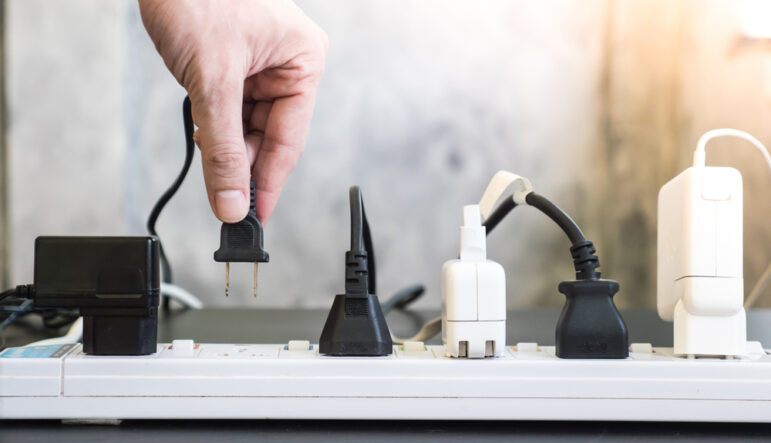
First things first: be aware of the distinction between a surge protector and a power strip. You simply get more outlets with a simple power strip. It offers no defense against surges. Metal oxide varistors, or MOVs, are the actual components of a surge protector that absorb excess voltage and stop it from damaging your gadgets.
When shopping for surge protectors, look for these features:
Don’t cut corners here. Although a high-quality surge protector costs $30 to $60, it is shielding equipment valued at hundreds or thousands of dollars. That’s a simple choice.
Installing a whole-home surge protector at your electrical panel is a major precaution. Before they reach your electrical system, this device captures significant surges from outside your house, such as those caused by lightning or utility switching. Installing it usually costs between $200 and $500, yet it simultaneously covers every item in your home. Consider individual surge protectors as your second line of defense and whole-home surge protection as your first. When combined, they offer complete protection.
Surges can enter through phone, cable, and ethernet lines, so quality surge protectors often include coverage for these connections. If not, separate inline protectors work too. For valuable electronics, protect every connection—not just the power cord.
During severe weather, the safest option is to unplug sensitive devices. It’s inconvenient, but it guarantees protection from major lightning surges. At the very least, unplug high-value electronics like TVs, computers, and gaming consoles.
Spend a few minutes checking your gadgets if you know there has been a power surge (whether the lights flickered, breakers tripped, or there was a lightning strike nearby). After turning on computers, check for odd patterns or error messages. Examine televisions and other entertainment devices. Verify the functionality of your internet. Check that the smart home appliances are still operating properly.
Before trying any fixes, note the issue if something isn’t functioning properly. Take pictures, record the event, and take note of any error messages. This information can be valuable for insurance or warranty claims and will help a residential electrician in Clayton, NC, quickly identify and address the issue.
Just because a device turns on doesn’t mean that everything is functioning properly. Damage from surges might be slight. Keep an eye out for odd behavior, crashes, or decreased performance over the following days. All of these could indicate damage from the surge that wasn’t immediately noticeable.
One of those issues that most people don’t consider until it’s too late is power surges. By then, you could be facing hours of setup time, hundreds or thousands of dollars in replacement costs, and possibly lost data or productivity. Our most dependable electronics—computers, entertainment systems, smart home appliances, home office equipment, and contemporary appliances—are also the most susceptible to surges. All of them have delicate parts that voltage spikes have the potential to kill.
The answer is straightforward. During severe weather, disconnect valuable gadgets, keep everything plugged into safe outlets, think about whole-home protection, and invest in high-quality surge protectors. You may avoid the hassle and cost of having to replace damaged equipment by following these easy steps.
Direct lightning strikes are too strong for your electronics, but most surges are minor occurrences that can be managed by good protection. Consider surge protection to be a form of insurance. When something goes wrong, you’ll be very happy you have it, even though you hope you never need it. Protect your home and electronics before the next surge hits—contact us today to schedule professional surge protection installation.